
The question in real estate (always and forever) is “Where are we in the cycle?” And the common answer is some non-sensical baseball inning analogy. In the following I will offer an approach that is analytical and hopefully interesting. At the very least it is better than guessing which inning we are in!
Warren Buffett historically hasn’t been known as a market timer but as I understand it there is one cyclical measure he does use. That metric compares the US stock market capitalization to US GDP. This measure has historically been a really good predictor of future returns. A hedge fund manager named John Hussman does a lot of work on that measure if you’re interested. I will walk through a method to use the same method to examine real estate across cities.
At a simple level, real estate is just an input to economic growth. White collar workers need office space to create goods, industrial companies require manufacturing space, etc. Given that, there should be a pretty direct relationship to the value of a key input (real estate) and the output (GDP or GMP). Using this relationship, the ratio of real estate market cap versus local city-level GMP is shown below for Madison and Boulder. It goes through cycles because real estate is more volatile than GDP. So at peaks, real estate takes up too much share of the economy, and vice versa. In Boulder, commercial real estate values have historically (since 1990) totaled 13% of local output. Today it is 19%, or 43% above “normal”.
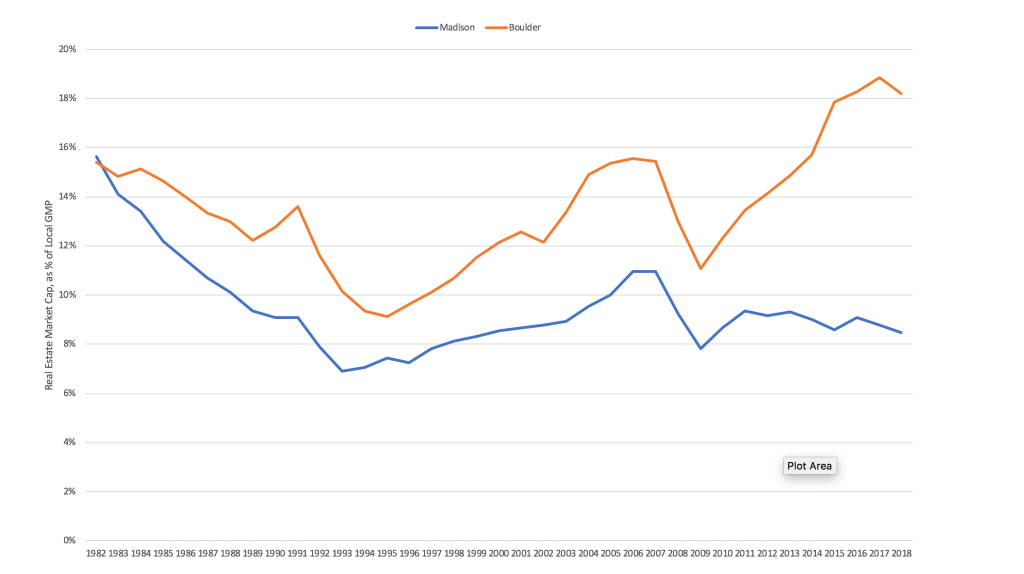
That metric makes Boulder look expensive, but does that matter? If you take the relative share of real estate at each annual data going back historically, and ask “what did real estate prices do over the next 5 years”, the summary answer is shown below. This data summarizes >25 years of data across 150 cities. As we would expect, when you invest when real estate is relatively depressed compared to the local economy, real estate prices grow over the next 5 years (those would be the left-hand bars in the graph). On average, when investing in areas where real estate is more than 30% overvalued compared to “norms”, prices fall an average of 5% per year over the ensuing 5 years. (recall, Boulder is 43% overvalued today and it is NOT the most expensive today…)
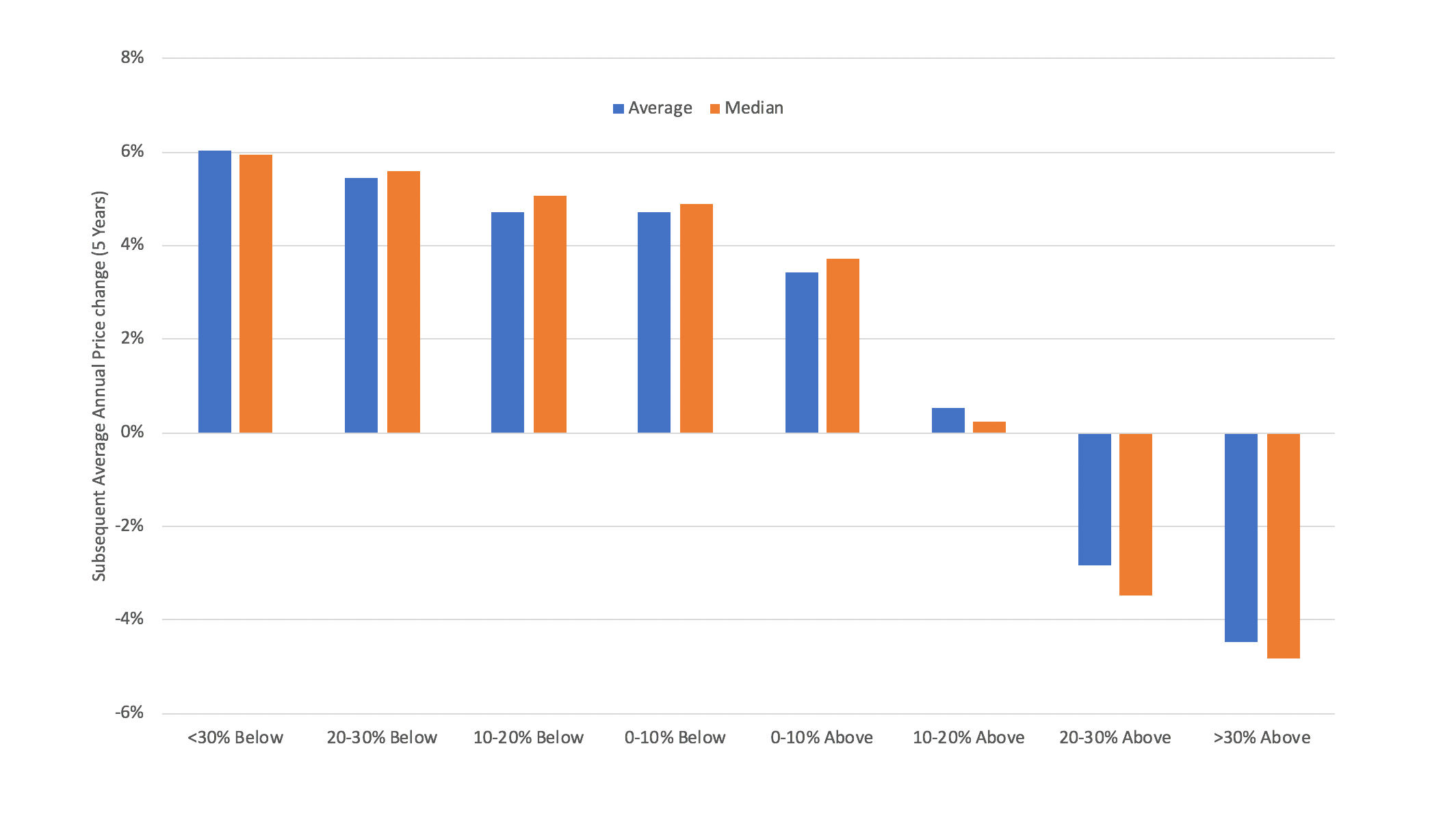
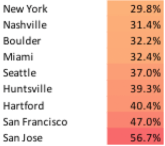
To me, this metric both makes intuitive sense and has been shown to work. According to this data, the most expensive areas to invest today are below. Those mostly feel right (except Huntsville and Hartford?). Through this entire data set, there have only been 3 examples when pricing was more than 50% above normal) and each time the market got destroyed over the next five years. The most expensive markets are shown today. Yes, Silicon Valley is 50% overvalued.
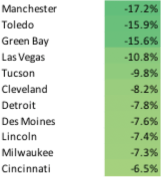
The least expensive today:
The ROTR target markets are (Nashville, Raleigh/Durham, SLC, Madison, Ann Arbor/Detroit, Pittsburgh, Columbus, Minneapolis) are 7% overvalued and the primary markets of Boston, NY, SF are 36% overvalued today.
I personally like this measure a lot and see only one potential flaw, and that is the potential for structural change, which seems like it could come two ways. One is if an industry just becomes way more important to the overall economy. For example, tech is more important than it was 20 years ago, so maybe some historical measures are too conservative (i.e. maybe Silicon Valley is only 30% overvalued). Second, and more likely, is if a city simply gets more white-collar and office-intensive through time. In NY and Boston, the office markets amount to 27% and 25% of GMP historically. Nashville looks expensive today, but it is still only 16%. This analysis will be wrong, and too conservative for fast-growing cities like Nashville if a lot of their growth is just convergence towards NY/Boston, as opposed to simply cyclical growth.
Regardless of that caveat, this metric makes me very comfortable taking risk in places like Pittsburgh, Minneapolis, Madison and Salt Lake City which, while popular, still seemed to be at normal prices.
Sources: CoStar Portfolio Strategy; BEA; Census

 ContrariLand
Leave a comment