
If there has been a single theme to the last decade it has been “disruption”: Existing industries altered by the introduction of new technology. As Marc Andreeson wrote more than a decade ago, Software is Eating the World. This collision between old industries and new technologies makes it easier and cheaper for new entrants to start a business, and more cost-effective to scale the business, making it harder for incumbents to compete.
However, it seems like software has only been gently nibbling on real estate. While billions have been raised in the PropTech category, the biggest and most well-known are seen as version of failures, such as Katerra and WeWork.
It seems like software will indeed eat real estate and to get a better idea of potential paths, lets look at some other large industries. Maybe this will offer some better clues, for when technology is ready to take some bigger bites of real estate.
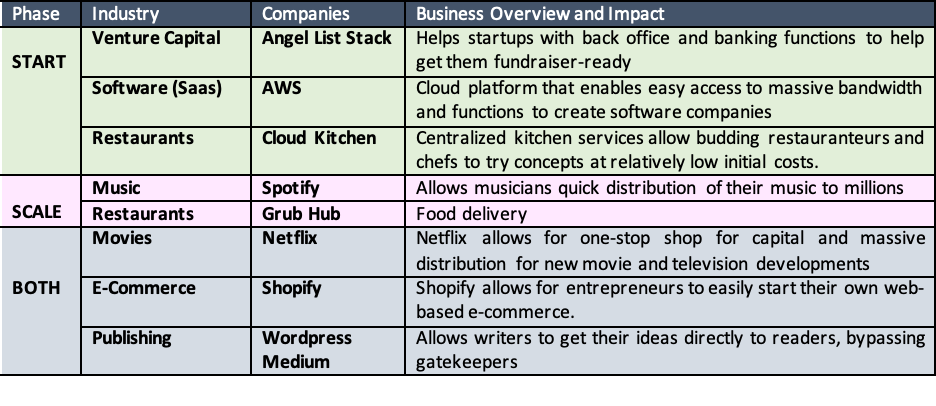
In the above, a number of successful companies have been created to help founders either start or scale companies to disrupt incumbents. These two factors- a) lower upfront costs to help enable new companies and b) lower marginal costs to scale the business seem to be the two potential avenues for a software to eat industries, with real estate being one eventual target, so let’s examine those two factors a bit more.
Lower Upfront Costs
Like real estate, almost all of the above industries are very capital intensive. The capital requirement keeps potential entrants out of the industry, decreasing innovation, entrepreneurialism and output. Through the years, think of the songs never recorded, restaurants never opened and businesses never started because there was no Shopify, Cloud Kitchen and AWS to facilitate the entrepreneurship. This especially impacts lower income entrepreneurs who have less access to this capital.
Real estate development is both very capital intensive and complicated, requiring a disparate group of skills not often present in a single person. The tool to better enable RE entrepreneurs to START could do some of the following:
- Help with basic paperwork and back office needs (like Angel List)
- Software to help with site selection, design concepts, underwriting tools (some versions of this exist today)
- Some help with access to predevelopment and land-capital
More Output and Scale
Even when entrepreneurs can build one of something, it has little impact unless they are able to scale. Technology aids in distribution, at a very low cost. So while thirty years ago I could technically record a song in my basement, I had no way to distribute it. Now, I can immediately post on Spotify and Youtube and see what happens. Some of the biggest songs in recent years have happened just this way.
I have ordered many customized baseball bats through LaCasse Bats. Their checkout process with a Shopify backend is seamless, allowing the owner of LaCasse to focus on making bats, not hiring engineers. This has allowed him to grow much more quickly than he would have otherwise.
How can software allow real estate investors and developers to scale rapidly? Potentially capital-focused concepts like Fundrise and Cadre are the answer, and that it is happening in front of our eyes, just more slowly in this industry.
Tying this to real estate
What would each of these companies look like for real estate?
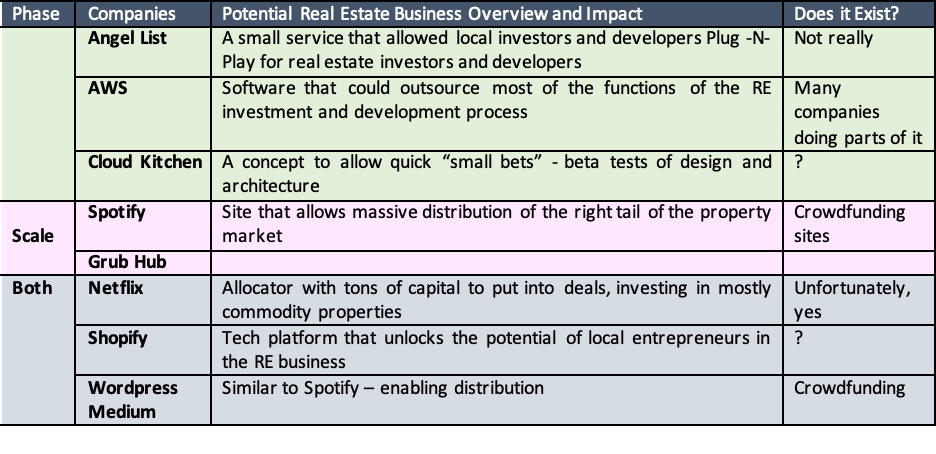
Going through this exercise of framing the two benefits of software – lower upfront costs to start and lower marginal costs to scale – is helpful to me, in thinking through the potential of technology to eat some more real estate. The amount of friction and gatekeeping in the industry should continue to allow for lots of new disruptive concepts.
Tech funding sites like Fundrise and Crowdstreet are getting traction, and are one area to help developers and investors scale. The biggest open question to me: who will create the businesses that allow more developers to start, and be the AWS for real estate?

 ContrariLand
Leave a comment