
I was watching an episode of Mad Men the other day. Don was looking at taking Howard Johnson as a client (the hotel, not the Mets 1980s-era third baseman). He and his wife stayed at the hotel and were awed by the cool colors and the service. The hotel is shown below. We can call this Hospitality 1.0. Don Draper – a picky consumer for sure – loved it, but we look at this product today and find it comical. As time passed, customers wants and needs evolved, ever upward. While roadside motels continued to be built, a new class of luxury hotels emerged, with spas and golf courses, an arms race to attract the next Don Drapers.

Fast forward 50 years and there is a huge swath of hospitality options. If I need to spend a single night in New York, my options range from “free” (couchsurfer.com) to more than $1,000 per night at the Four Seasons. These options mirror the industry, as investors and developers have recognized this breadth of consumer demand and created products to satisfy it. As with most goods, there is a trade-off between cost and quality. In hospitality, there are lots of affordable road-side mom and pop operations, very unique boutique properties, as well as the corporate gamut from Motel 6 to the Ritz.
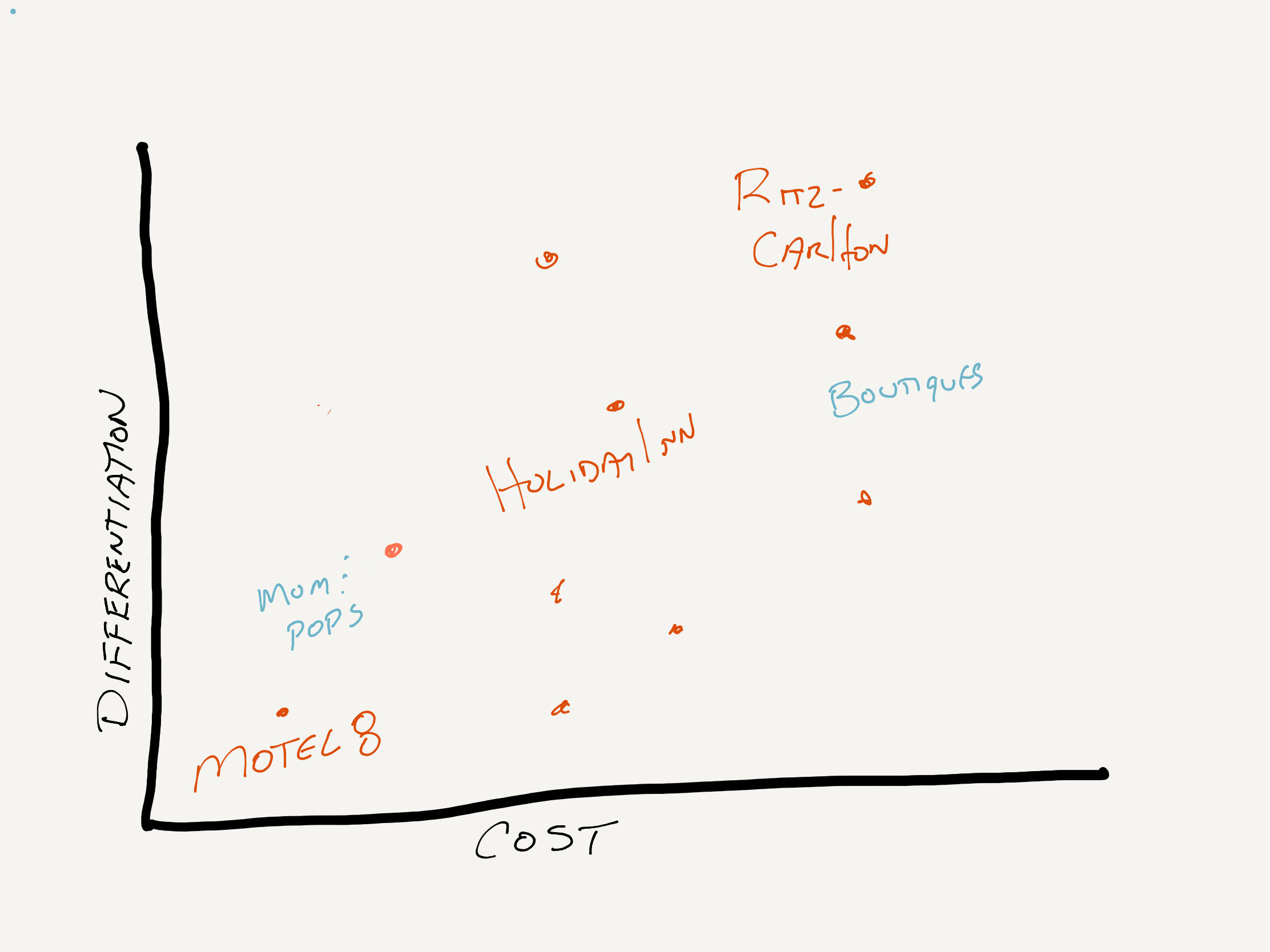
This seems like the most likely path for office co-working as well. There should be a number of different players, to satisfy broad needs. Why shouldn’t there be a pure budget version that competes on cost? It can serve Folgers and have old carpets. And there could be a very high-end provider that caters to executives and hedge funds. It can offer services like sound-proof offices and super-fast internet.
As yet another trip in the way-back, Host Properties and Marriott split in 1992, with the latter taking the management and the former taking the properties. This PropCo/OpCo split unlocked a lot of value and created a more sensible capital structure. Today Marriott is worth $39 billion and Host is worth $14 billion. According to Costar, the U.S. office market valuation is $2.5 trillion, so it certainly seems like an office property management services as an industry can be $200+ billion. While WeWork’s current valuation of $42 billion might sound absurd, if given enough time it might seem reasonable.
Hot Take #1: WeWork is Howard Johnson’s, and it is early in this game.
I was listening to a podcast with Danny Meyer the other day. He said that in the restaurant business, customers had come to believe that you must choose between: 1. Speed. 2. Quality and 3. Price. At best, you can only get two out of the three. So you can go to a great three star restaurant, but it will be expensive and slow. Or you can get food that is fast and cheap, but it will taste awful. He argued that maybe you could cut those up differently, and get to two points in a different way. By putting 2/3 of a point into each category he created Shake Shack.
Let’s analogize that to real estate. Say you can get either: 1. Location 2. Price or 3. Services. Historically there has really only been location and price, and there is a rough-trade off. Would a tenant be less demanding on location in exchange for better services?
Let’s hop back to Mad Men for a minute. This picture shows their lunch cart in the office. Actually this picture isn’t great, but they actually did have sandwiches and such. Also, recall the “open floor plan” they had! All of these things have been done before. In fact, white collar workers historically worked in a fairly open environment until the demon cubicle was hatched.

Hot Take #2: As long as tenants are cost-conscious, there could be a services/location trade-off, making some seemingly secondary locations more attractive. (note: this is a “hot take”, not one I necessarily subscribe to)
As usually happens, the new concepts initially take hold in cool, big cities and then filter down to smaller areas through time. According to CoStar, co-working currently amounts to roughly 1.5% of all office space in New York City. This will certainly grow, especially as a reported 20% of all leasing was flexible in the most recent quarter. However, the rate is far lower in secondary cities such as Minneapolis and Denver, and providers are even more fragmented there. For instance, WeWork isn’t in Pittsburgh today, a city that is serviced nearly entirely by mom and pop co-working providers.
Hot Take #3: Just as many cities are under-hoteled, there are a number of areas that are under-coworked today. These areas create a great opportunity for new brands to capitalize.
The summary of the takes? It is very early in co-working, and the winners are far from decided. There is space in the market for numerous brands and concepts and we should all welcome more competition!

 ContrariLand
Leave a comment